In most T-bone accidents, the answer to who’s at fault points to the driver who failed to yield the right-of-way, typically by running a red light or making an unsafe turn into oncoming traffic. However, assigning legal responsibility after a crash in Pembroke Pines or anywhere in South Florida is often more complex than it appears.
Proving fault requires more than just knowing basic traffic rules. A thorough investigation may reveal that other critical factors, such as excessive speed, distracted driving, or even shared blame, played a crucial role.
For victims of these serious crashes, from the busy intersections of Pines Boulevard to quiet neighborhood streets, uncovering the complete truth with the guidance of a Pembroke Pines car accident lawyer can help empower you during a time when you might feel powerless.
Understanding T-bone Accidents in Florida
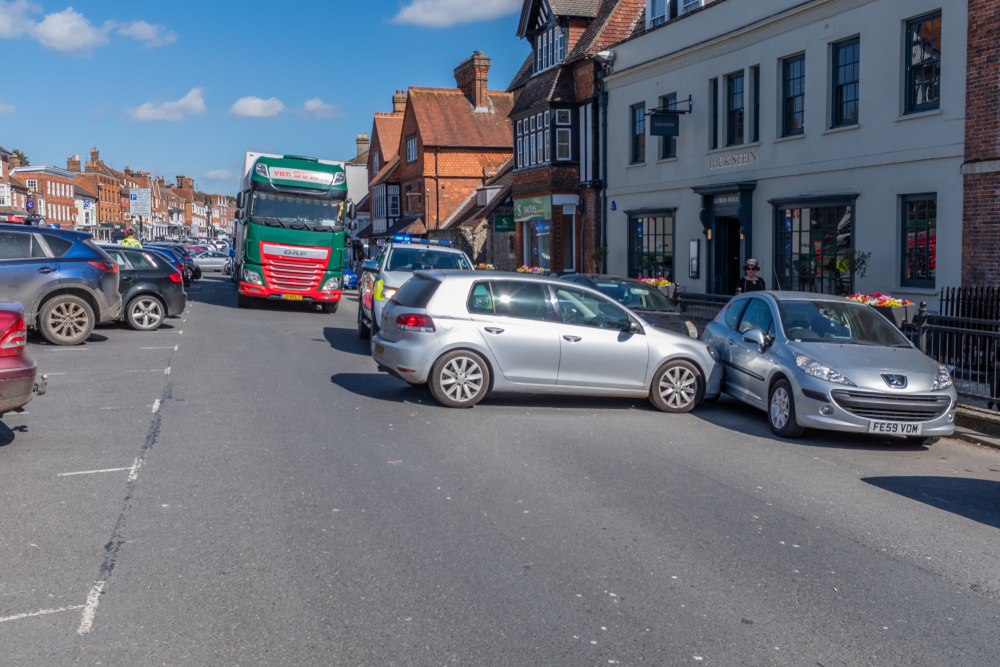
A T-bone, or side-impact, crash happens when the front of one vehicle collides with the side of another, forming a "T" shape. These accidents most frequently occur at intersections, from busy crossroads like Pines Boulevard and Flamingo Road to smaller neighborhood crossings. They are particularly dangerous because the side of a vehicle offers far less protection than the front or rear, where bumpers and engine blocks can absorb some of the force.
The force of the impact is transferred more directly to the driver and passengers, leading to a high risk of serious injuries. According to the Insurance Institute for Highway Safety (IIHS), side-impact crashes accounted for 23% of passenger vehicle occupant deaths in a recent year. This statistic highlights the serious nature of these collisions and underscores the importance of holding the responsible party accountable for the harm they cause.
The Basics of Determining Fault: Right-of-Way Rules
In most T-bone accident cases, the question of fault comes down to a simple but critical concept: the right-of-way. In plain English, the right-of-way is the legal right of a driver, pedestrian, or cyclist to proceed first in a particular situation on the road. When a driver violates another's right-of-way, they are often found to be at fault for any resulting crash.
Florida law sets clear rules for who has the right-of-way in different traffic scenarios. Common situations where these rules apply include:
- Intersections with Stop Signs: At a four-way stop, the driver who arrives first has the right-of-way. If two drivers arrive at the same time, the driver on the right has the right to proceed first. At a two-way stop, drivers on the road without a stop sign have the right-of-way.
- Intersections with Traffic Lights: A driver facing a green light has the right-of-way. Drivers must stop for a red light. A yellow light is a warning that the signal is about to change to red, and drivers should prepare to stop or clear the intersection if they are already in it.
- Making Left Turns: A driver turning left at an intersection must yield the right-of-way to all oncoming traffic that is close enough to be a hazard. This is a very common cause of T-bone accidents.
A violation of these rules, as outlined in laws such as Florida Statutes § 316.123 concerning vehicle-turning-left, often points directly to the negligent driver.
The Role of Negligence in a T-bone Accident Claim
Beyond traffic violations, personal injury claims are built on the legal concept of negligence. Negligence is a legal term that simply means someone acted carelessly or failed to act with reasonable caution, and their actions caused injury to another person. Proving that another driver was negligent is the key to a successful personal injury claim.
To establish negligence, four specific elements must be demonstrated:
- Duty of Care: Every driver on the road has a legal duty to operate their vehicle in a safe and responsible manner to avoid harming others. This is an automatic responsibility for anyone who gets behind the wheel.
- Breach of Duty: The at-fault driver breached, or violated, this duty. This could be through a specific action like running a red light, or a general failure like driving while distracted.
- Causation: The driver's breach of duty must be the direct cause of the T-bone accident and the resulting injuries. The collision would not have happened if not for the driver's careless actions.
- Damages: As a result of the accident, you suffered actual harm. These are known as damages and can include medical expenses, lost income from being unable to work, property damage to your car, and pain and suffering.
When these four elements are present, the driver who caused the crash can be held legally and financially responsible for the harm they inflicted.
Who Is at Fault for a T-bone Accident? Common Scenarios
While every accident is unique, most T-bone crashes fall into a few common patterns. Analyzing these scenarios can help clarify how fault is typically assigned.
A Driver Runs a Red Light or Stop Sign
This is one of the most straightforward examples of fault. A driver who ignores a traffic signal or a stop sign is clearly violating traffic laws and breaching their duty of care to other drivers who have the legal right-of-way. In these cases, the driver who ran the light or sign is almost always found to be at fault.
An Unprotected Left Turn Goes Wrong
Many T-bone accidents occur when a driver attempts to make a left turn at an intersection without a green arrow. The turning driver is required by law to yield to oncoming traffic. If they misjudge the speed or distance of an approaching car and turn into its path, they are typically held responsible for the resulting collision.
While there can be exceptions, such as if the oncoming driver was speeding excessively or ran a red light, the initial burden is on the turning driver to wait until it is safe to proceed.
A Driver Is Speeding or Driving Recklessly
Speeding dramatically increases the risk and severity of any accident. A driver who is traveling well over the speed limit has less time to react to changing conditions and requires a longer distance to stop. Even if another driver makes a mistake, the speeding driver’s actions can be a major contributing factor to the crash.
For example, if a driver turning left believed they had enough time to clear the intersection based on normal traffic speeds, the excessive speed of an oncoming car could make them partially or fully at fault for the crash.
A Driver Is Distracted or Under the Influence
Driving requires a person’s full attention. A driver who is texting, talking on the phone, eating, or otherwise distracted cannot react appropriately to traffic signals or other vehicles. Similarly, a driver whose judgment is impaired by alcohol or drugs is a danger to everyone on the road. In a T-bone accident investigation, proof of distraction or impairment is powerful evidence of negligence and fault.
What Happens if Both Drivers Share Some Fault? Florida’s Comparative Negligence Rule
Sometimes, the answer to "who is at fault for a T-bone accident" is not just one person. An investigation can show that both drivers contributed to the crash. For instance, one driver may have made an improper left turn, but the other driver was speeding and could have avoided the crash if they had driven the speed limit. In these situations, Florida law applies a rule called "pure comparative negligence."
This rule, found in Florida Statutes § 768.81, allows you to seek compensation even if you were partially at fault for the accident. Your total compensation award is simply reduced by your percentage of fault.
For example, if you are found to be 10% at fault for the accident, you would be able to recover 90% of the damages. This system allows for a fair outcome that reflects the reality that accidents are sometimes complex events with more than one contributing cause.
Gathering Evidence to Prove Who Is at Fault
After you have received medical attention and are safely back home, your focus may turn to how you will prove what happened. A strong personal injury claim relies on strong evidence. The insurance company for the at-fault driver will look for any reason to deny your claim or reduce its value, so collecting and preserving evidence is critical.
Key pieces of evidence can help paint a clear picture of the accident and establish fault:

- The Official Police Report: The responding officer's report will contain important details, including their initial assessment of how the accident occurred, any traffic citations issued, diagrams of the scene, and witness statements.
- Photographs and Videos: If you were able to, photos of the vehicle positions, damage to both cars, skid marks on the road, and the traffic signals at the intersection can be invaluable. Photos of your injuries are also important.
- Witness Contact Information: Independent witnesses who saw the crash can provide unbiased accounts of what happened. Their testimony can be crucial in confirming your version of events.
- Medical Documentation: Keep detailed records of all doctor's visits, treatments, prescriptions, and therapy sessions. These records create a direct link between the T-bone accident and the injuries you sustained.
- Intersection Camera Footage: Many busy intersections, including those around commercial areas like the Shops at Pembroke Gardens, are monitored by traffic or security cameras. This footage can provide indisputable proof of a driver running a red light or making an improper turn.
Each piece of evidence you collect helps build a strong foundation for your claim.
How an Attorney Helps Determine Fault and Build Your Case
Trying to piece together the evidence and argue with insurance adjusters on your own is a heavy burden. An experienced personal injury attorney can take this weight off your shoulders. Their job is to manage the legal process so you can focus on your health and well-being.
A dedicated legal advocate can assist you by:
- Launching a Private Investigation: An attorney can go beyond the initial police report, securing evidence like traffic camera footage, cell phone records (if legally obtainable), and vehicle "black box" data that might show the speed of the vehicles at impact.
- Consulting with Reconstruction Professionals: In complex cases, accident reconstructionists can use physics and engineering principles to create a scientific model of the crash, providing a clear and authoritative opinion on how it happened and who was at fault.
- Managing Insurance Company Communications: Attorneys are skilled in communicating with insurance adjusters. They know the tactics adjusters use to minimize payouts and will handle all phone calls, paperwork, and settlement discussions on your behalf.
- Calculating Your Total Damages: They will work to identify all your losses, including future medical needs, lost earning capacity, and the non-economic costs of your pain and suffering, to pursue a fair settlement that covers all your needs.
Having a knowledgeable professional in your corner can make a significant difference in the outcome of your case and your ability to get the resources you need to move forward.
Fault in a T-bone Accident FAQs
Here are answers to some common concerns people have after a side-impact collision.
How long do I have to file a claim for a T-bone accident in Florida?
Florida has a law known as the statute of limitations, which sets a deadline for filing a lawsuit. For most personal injury cases based on negligence, including car accidents, you generally have two years from the date of the accident to file. If you miss this deadline, you will likely lose your right to seek compensation in court.
What if a vehicle malfunction, like bad brakes, caused the T-bone accident?
If a mechanical failure was the cause of the crash, fault might lie with a third party, not just the other driver. For example, if faulty brakes prevented a car from stopping at a red light, the vehicle's manufacturer, a parts supplier, or a mechanic who performed a faulty repair could be held responsible through a product liability claim.
Can a passenger in a T-bone accident file a claim?
Absolutely. Passengers are almost never at fault for an accident. An injured passenger has the right to file a claim against the insurance policy of the at-fault driver. If both drivers shared some level of fault, the passenger might be able to file a claim against both policies.
Contact a Trusted Car Accident Lawyer Today

Suffering injuries in a T-bone accident can be stressful. You are likely dealing with physical pain, mounting medical bills, and uncertainty about the future. You need an experienced advocate to help lift your burden.
At Garnes Injury Law, our team, led by Attorney Erika V. Garnes, is committed to providing personalized and compassionate representation to the residents of Pembroke Pines and the diverse communities of South Florida. We believe in direct communication, sitting down with our clients to understand their unique situation and develop a clear plan forward. With services available in both English and Spanish, we are prepared to be your voice, fighting fiercely on your behalf.Don’t let your injuries go unanswered. Contact the dedicated Pembroke Pines personal injury lawyers team at Garnes Injury Law today at (954) 905-2683 or through our online form for a free consultation to discuss your T-bone accident case and legal options.